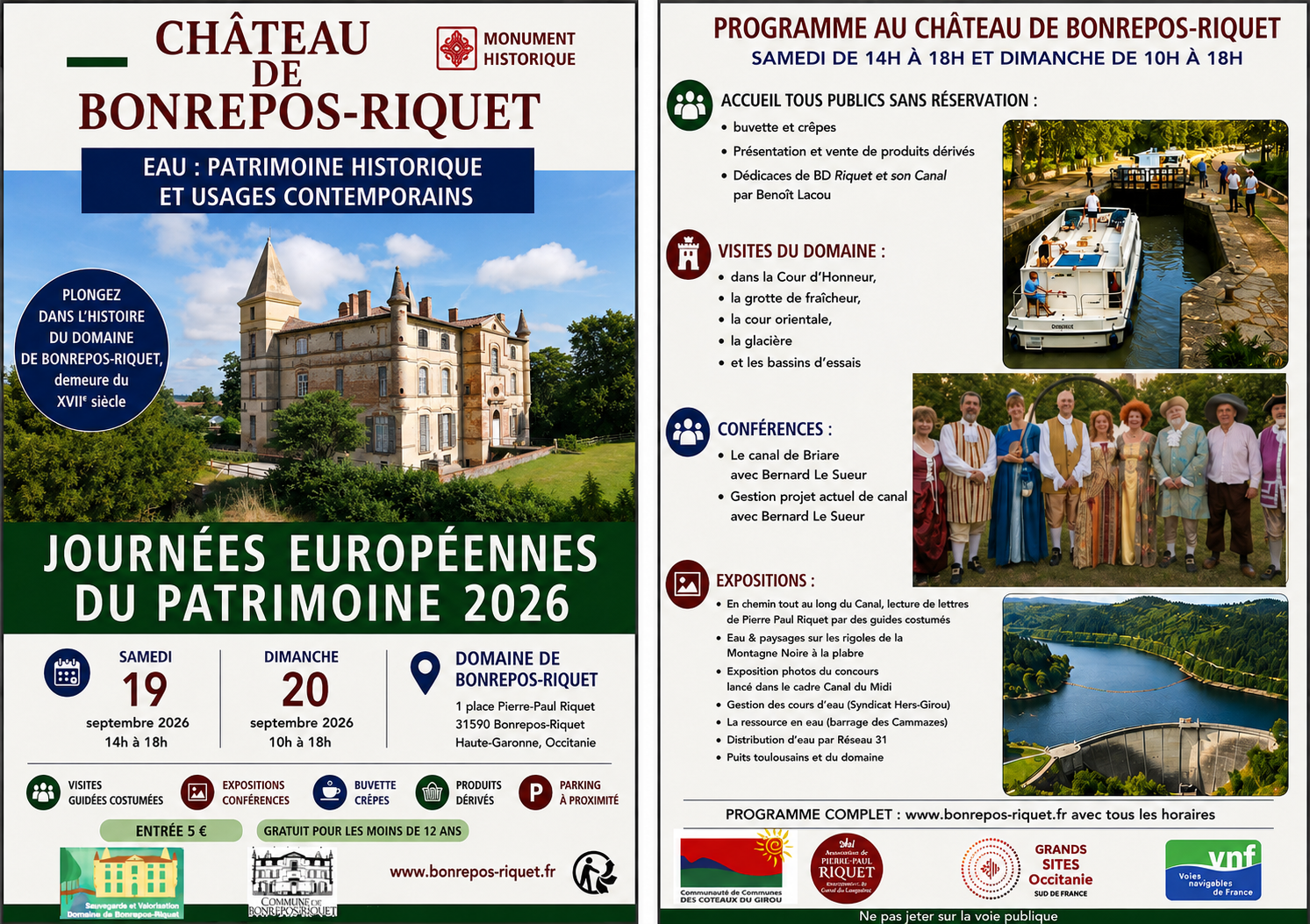
BONREPOS-RIQUET
WATER: Historical Heritage and Contemporary Uses
The Canal du Midi is now a World Heritage Site. Its presence seems unchanging, like that of a peaceful watercourse, but what do we know of the engineering works required to make it navigable?
The aim of these European Heritage Days is to highlight the link between this remarkable heritage structure – which was initially an efficient means of transporting goods (linked to the ports of Toulouse and Cette) – and the upstream structures that ensured its water supply.
Whilst the first reservoirs (St Ferréol, Le Lampy) provided the water needed for the canal, it very quickly became apparent that contemporary uses of the water would extend to agricultural irrigation, livestock watering, and then, from the second half of the twentieth century, to the supply of drinking water to the inhabitants of the Lauragais (Les Cammazes, La Galaubbe, etc.).
The Canal du Midi forms part of a complex system in which its heritage function is linked to, or indeed dependent upon, reservoirs set aside for contemporary uses.
To this end, we shall present the correspondence exchanged by P. P. Riquet during the construction of the Canal Royal du Languedoc (based on the map drawn up by Garipuy in 1771), as well as the contemporary organisations that manage water resources from the Montagne Noire, the distribution of drinking water by Réseau 31, and the development of the Hers and Girou watercourses, not to mention a presentation of Toulouse’s wells and the Bonrepos-Riquet area.
As in previous years, presentations by costumed guides on the history of Riquet and the Bonrepos estate will bring these two days to life.