TOULOUSE
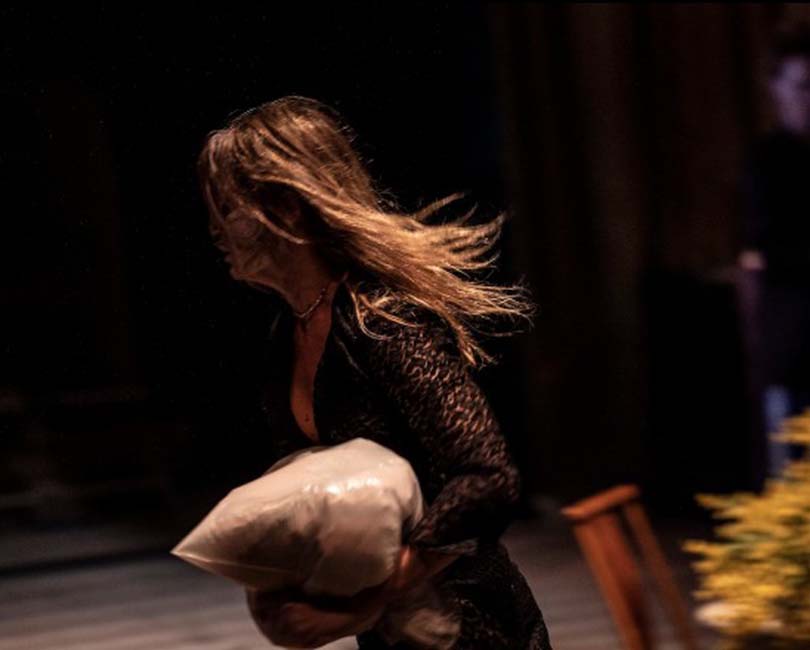
For her directorial debut at the Comédie-Française, Lorraine de Sagazan has taken on the challenge of creating a wordless production to explore how theatre can serve as a medium for expressing characters’ inner states. This is not an adaptation of an Antonioni screenplay, but an original play inspired by his artistic approach – from the tetralogy centred on ‘the sickness of the heart’ ’ (L’Avventura, La Nuit, L’Éclipse and Le Désert rouge), right through to his short stories and unproduced screenplays. The play brings together themes dear to the filmmaker, such as disappearance, the abandonment of feelings and the instability of perception.
The director, a resident at the Villa Medici in 2022–2023, has been collaborating with the playwright Guillaume Poix for some time, beginning in 2019 with *L’Absence de père*, a free adaptation of Chekhov’s *Platonov*, followed by *La Vie invisible* and *Un sacre*. For this project, which challenges theatrical conventions, he has written numerous texts, including interior monologues that were used in the actors’ preparatory work.
In this way, they have created an immersive production in which the audience follows the plot not through the interpretation of words, but through that of gestures and glances, whilst the smallest details take on an unusual eloquence. Set within a dual-front stage configuration, like a long sequence shot with unity of place and time, the production offers the audience the freedom to create their own ‘montage’. Seated as close as possible to the stage, the performers’ bodies and faces, they uncover, within the secrets of the silences, the expressive richness of their inner landscapes.